


Why Cybersecurity Risk Assessments Matter
Many business owners believe they’re protected because they have antivirus software, firewalls, or cloud backups in place. While those tools are essential, they only represent individual pieces of a much larger cybersecurity strategy.
A cybersecurity risk assessment evaluates your entire technology environment to identify vulnerabilities that attackers could exploit. It looks beyond software by reviewing how employees access systems, how sensitive data is stored, whether security policies exist, and whether your organization can respond effectively if an incident occurs.
Think of it as a comprehensive health check for your business’s technology. Rather than waiting for something to break, a risk assessment identifies weaknesses early so they can be addressed before they become costly problems.
For businesses across Olympia, Lacey, Tumwater, and the surrounding South Sound region, this proactive approach helps reduce operational risk while supporting long-term business continuity.
Why Risk Assessments Come Before Compliance
Cybersecurity frameworks and regulations such as the NIST Cybersecurity Framework, PCI DSS, and the FTC Safeguards Rule often require or recommend that organizations understand their risks before implementing security controls.
Without a risk assessment, businesses often spend money on security tools without knowing whether they’re addressing the right issues.
For example, a company may invest in advanced endpoint protection but overlook weak password policies, outdated software, or employees using personal devices without proper security controls. These overlooked gaps can still expose the business to cyber threats and cybersecurity compliance issues.
A professional assessment helps organizations prioritize improvements based on actual risk rather than assumptions. It also establishes a baseline for future cybersecurity improvements, making it easier to prioritize technology investments and demonstrate progress over time.

Cybersecurity compliance depends on verified controls, documented processes, and evidence that those protections are consistently followed.
Common Cybersecurity Risks Small Businesses Overlook
Many small and mid-sized businesses face similar security challenges regardless of industry.
Some of the most common findings include:
i) Employees reusing passwords across multiple accounts
ii) Missing Multi-Factor Authentication (MFA)
iii) Outdated operating systems and software
iv) Unsecured remote work devices
v) Excessive employee access permissions
vi) Lack of documented security policies
vii) Incomplete or untested backups
viii) No formal incident response plan
Individually, these issues may seem manageable. Together, they create opportunities for cybercriminals to gain access to sensitive business information.
Regular risk assessments help identify these gaps before attackers do.
What Happens During a Professional Cybersecurity Risk Assessment?
A professional cybersecurity assessment is designed to provide a complete picture of your organization’s security posture.
Depending on your environment, the assessment may include:
i) Network and infrastructure review
ii) Endpoint security evaluation
iii) Microsoft 365 or cloud security review
iv) Backup and disaster recovery assessment
v) User access and permission analysis
vi) Multi-Factor Authentication verification
vii) Patch management review
viii) Security policy documentation review
ix) Compliance gap assessment
x) Employee security awareness evaluation
The result is a prioritized roadmap showing which improvements should be addressed first based on business risk.
Rather than receiving a long list of technical findings, business owners gain practical recommendations that align with their operations and goals.
Risk Assessment vs. Compliance Audit
Although the two terms are often used interchangeably, they serve different purposes.
| Risk Assessment | Compliance Audit |
| Identifies security risks | Verifies compliance with specific regulations or contractual requirements |
| Focuses on improving security | Focuses on meeting established requirements |
| Helps prioritize investments | Confirms required controls are in place |
| Can be performed proactively | Often required by clients, vendors, or regulators |
Most organizations begin with a cybersecurity risk assessment before pursuing formal compliance initiatives.
Why Local Businesses Benefit from a Trusted Technology Partner
Cybersecurity is constantly evolving. New threats, changing regulations, and emerging technologies make it difficult for many business owners to keep up while also running their organizations.
Partnering with an experienced managed IT provider gives businesses access to specialized cybersecurity expertise without hiring additional internal staff.
For more than 20 years, PC Technologies has helped businesses throughout Olympia, Lacey, Tumwater, Thurston County, Lewis County, and Grays Harbor County strengthen their technology environments through proactive IT management and cybersecurity services.
Rather than applying one-size-fits-all solutions, PC Technologies works with businesses to understand their operations, identify risks, and recommend practical improvements that support both security and business objectives.
Signs Your Business Should Schedule a Cybersecurity Review
If any of the following apply to your organization, it may be time for a professional cybersecurity review:
i) Your business has never completed a formal cybersecurity review.
ii) Employees work remotely or use personal devices for business.
iii) You’re unsure whether your backups would actually recover after an attack.
iv) Clients are asking security or compliance questions.
v) Your business stores financial, legal, or confidential customer information.
vi) Your technology has grown over several years without a strategic security review.
Addressing these concerns proactively is significantly less disruptive than responding to a cyber incident after it occurs.
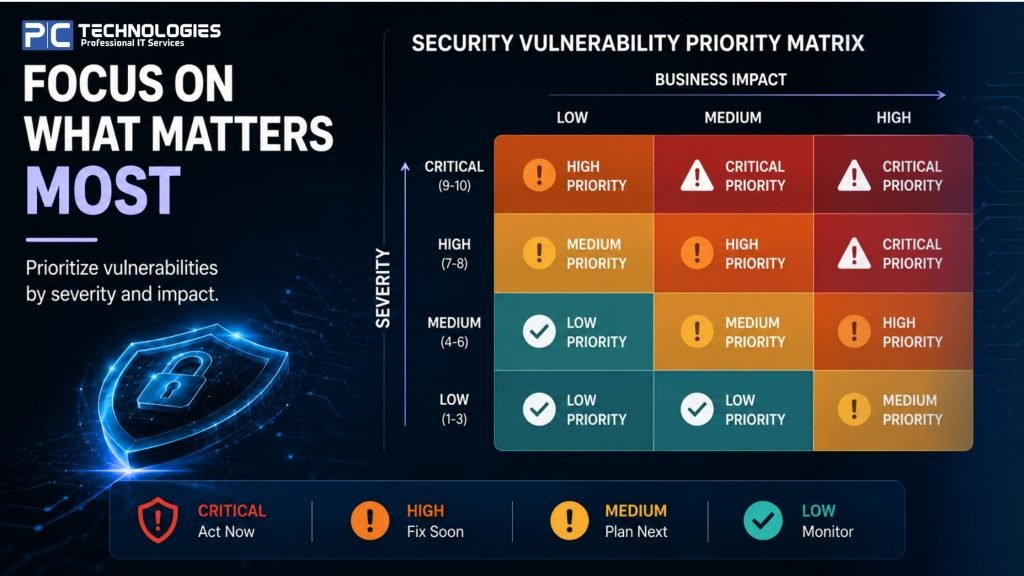
A risk assessment turns technical findings into a prioritized roadmap based on business impact and urgency.
Frequently Asked Questions
1. How often should a cybersecurity risk assessment be performed?
Most businesses should complete a comprehensive assessment at least once a year or whenever significant technology changes occur.
2. Is a cybersecurity risk assessment required for compliance?
Many cybersecurity frameworks and regulatory standards either require or strongly recommend regular risk assessments as part of an organization’s overall security program.
3. How long does a cybersecurity risk assessment take?
The timeline depends on the size and complexity of your environment. Many small businesses can complete an assessment within a few days to a few weeks.
4. Can small businesses benefit from a cybersecurity assessment?
Absolutely. Small businesses are increasingly targeted because attackers often assume they have fewer security resources. A risk assessment helps identify vulnerabilities before they become costly incidents.
Schedule a Cybersecurity Review
Cybersecurity isn’t just about installing security software—it’s about understanding where your business is most vulnerable and taking practical steps to reduce risk.
If you’re unsure how well your current security measures support your business or compliance requirements, a professional cybersecurity review provides a clear starting point.
PC Technologies helps businesses across Olympia, Lacey, Tumwater, Thurston County, Lewis County, and the South Sound region identify security gaps, strengthen their defenses, and build a technology strategy that supports long-term success.
Schedule a Cybersecurity Review with PC Technologies today and gain confidence that your business is prepared for tomorrow’s cybersecurity challenges.
Recent Posts
Where Business IT Goes Wrong and How to Get It Back on Track
PC Technologies helps Olympia businesses fix the IT problems that cause downtime and leave data…
Managed IT Services Or Break-Fix Support: Which Is Better for Your Shelton Business?
Shelton businesses run on lean teams and full schedules. When a server crashes, a phishing…